W-2 vs. 1099: The Pros and Cons of Leaving Corporate Stability
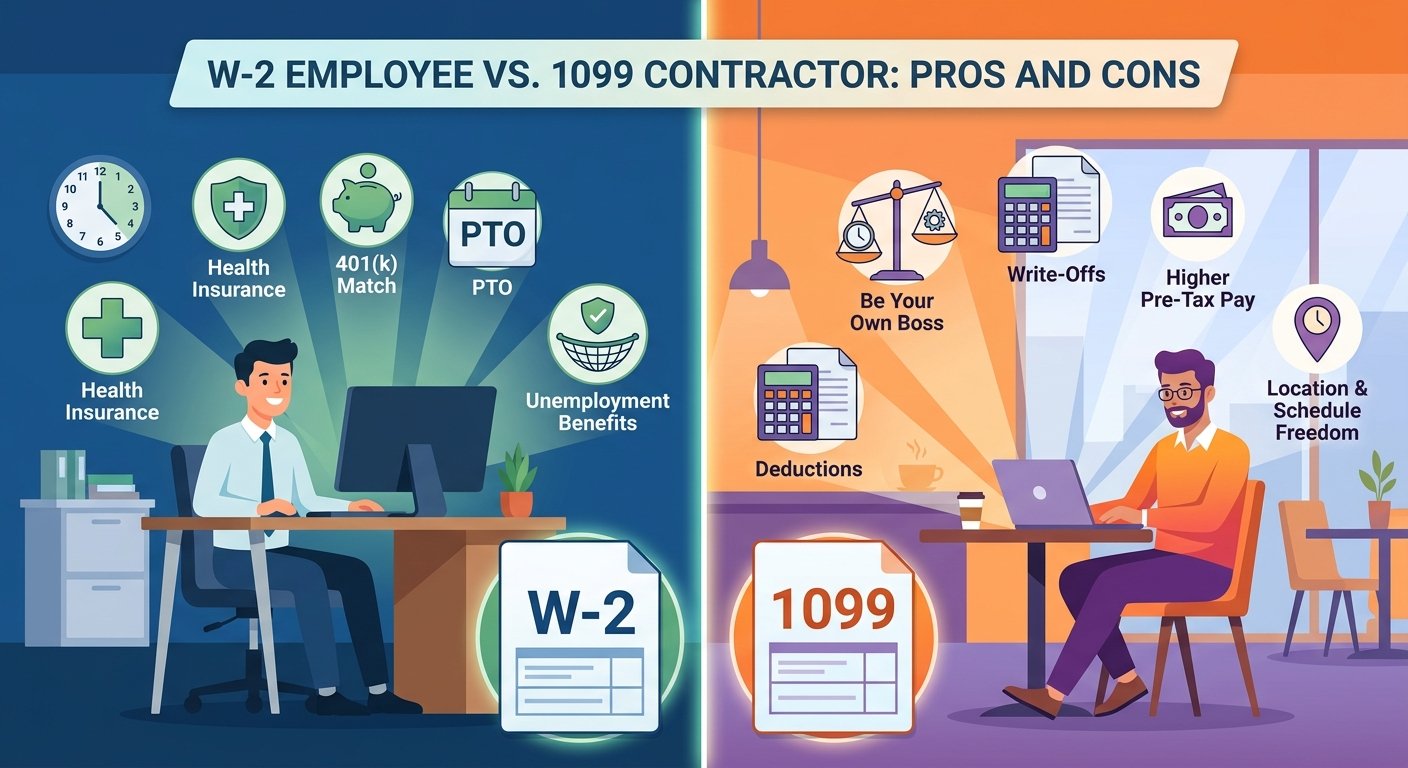
For many in the corporate world, the jump to becoming a 1099 contractor or self-employed is perceived as the ultimate jump into personal freedom. The thought of setting your own hours, dumping bad bosses, and working in your sweatpants is quite alluring.
The reality of leaving a regular W-2 job for contract work, however, requires more than just a transition from employee brain to entrepreneur brain. All the rules of engagement with money, benefits, operational costs, and personal risk are entirely different. Let’s examine the money, legal, and operational realities of jumping from W-2 security to a 1099 career with honesty.
1. Predictable and guaranteed income or potentially unlimited income
The W-2 Reality: Safe and steady paycheck.
Every two weeks or monthly, the money hits your bank account regardless of whether the company is experiencing lean times or has just lost its largest client. It’s your employers responsibility to obtain customers, invoice, retain clients and deal with operating expenses. Even in a slow sales month, you still get paid.
The 1099 Reality: Unpredictable, unbounded earnings.
Once you become a 1099 consultant, your earnings potential now has no ceiling – and it has no floor either. It’s simple: if you don’t actively accomplish what you are being paid to deliver during business hours or on project time, you won’t get paid.
- Pros: Your rates are up to you. You could potentially make many more earnings a month than you ever would as a W-2 employee by acquiring several clients at once, raising your rate or leveraging scalable systems.
- Cons: Your cash flow may become erratic (feast or famine). Your clients late payments and scope creep are now your problem to solve, and you will be responsible for finding work when you reach periods of inactivity.
2. Tax Responsibilities: A Wake Up Call for the New 1099 Contractor
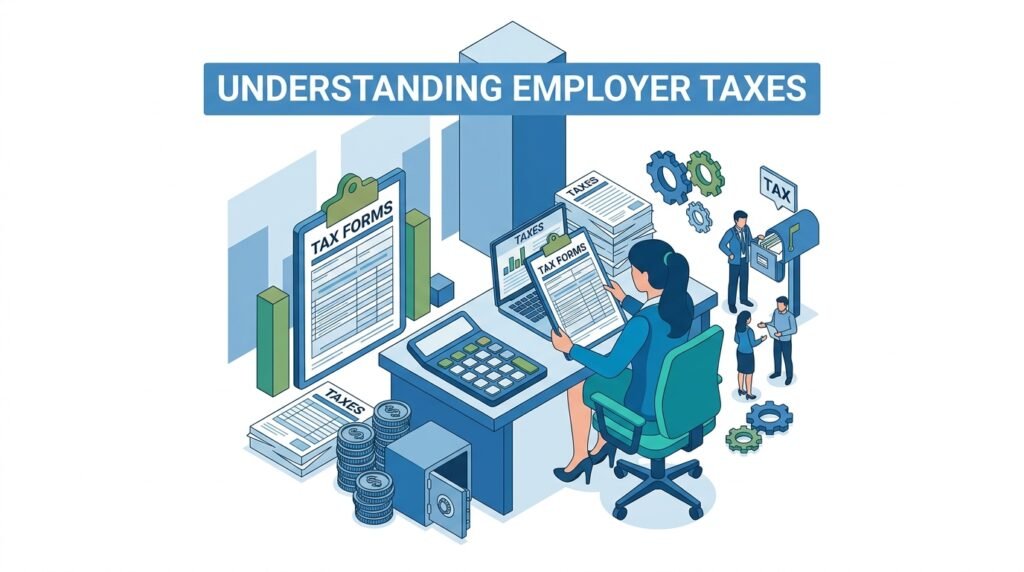
Perhaps the most significant monetary jolt to new 1099 contractors arises once they’re hit with tax season.
| W-2 Employee Taxes | 1099 Self-Employed Taxes |
| • FICA: 7.65% withheld from pay• Employer matches 7.65%• Automatic tax withholding | • SE Tax: 15.3% full burden• Quarterly estimated payments • Schedule C business write-offs |
The “Employer Share” Disappears
As a W-2 employee, your employer covers half of your FICA contributions – those Social Security (6.2%) and Medicare (1.45%) taxes that keep those essential programs up and running. If you are an independent contractor, your business not only owes the entire amount to the IRS, but you essentially act as the employer as well. That means the entirety of 15.3% Self-Employment (SE) tax (your employer’s share plus yours combined FICA taxes at 7.65% plus another 7.65% from you, or 12.4% Social Security until your earnings surpass a certain yearly limit and 2.9% Medicare) is your responsibility. However, you may deduct one-half of what SE tax costs you (a deduction up to your AGI for 7.65%).
Quarterly Taxes and Tax Deductions
While W-2 employees have their taxes taken out of each paycheck-so you don’t have to think about it until tax day-that’s not the case for 1099 independent contractors. To avoid an IRS penalty for underpayment, you have to do this yourself-you make estimated tax payments every quarter (Form 1040-ES).
The good news? The advantage that was lost in not having taxes withheld upfront is regained in taking deductions upfront. You can write off a lot of business expenses-from your home office share of your utility bill, business software, continuing education or licensing, health insurance through the self-employed health insurance deduction.
3. Benefits & Safety Nets: Funding Your Own Infrastructure
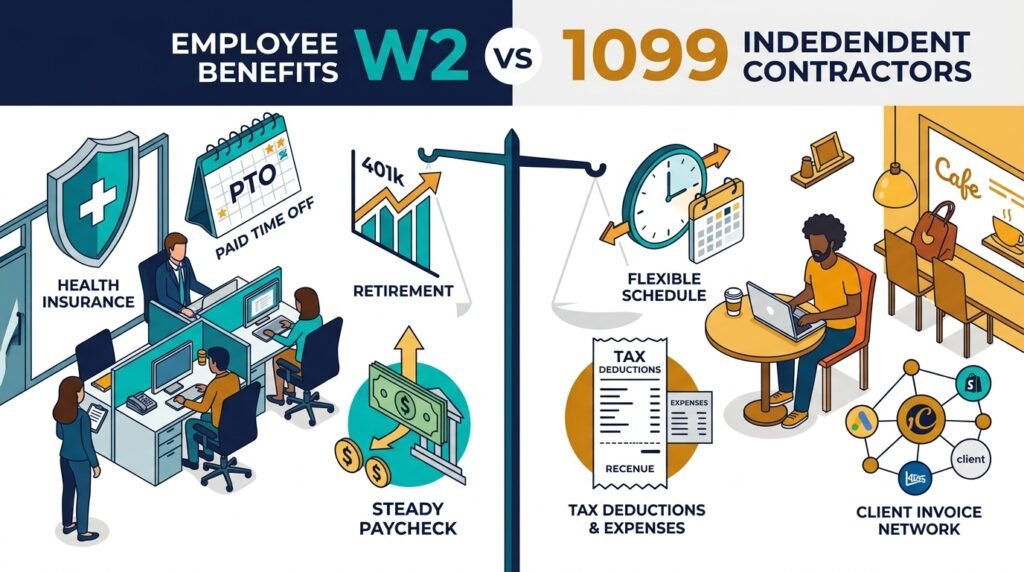
Once you exit the corporate workforce, so too does employee benefits package. You need to develop, finance, and administer your own fallback cushion.
| Corporate Benefit | 1099 Self-Funded Equivalent |
| Health / Dental Insurance -> | ACA Marketplace / Private Individual Plan |
| 401(k) Matching -> | Solo 401(k) or SEP-IRA |
| Paid Time Off (PTO) -> | Built into higher hourly/project rates |
| Disability / Life -> | Private individual insurance policies |
Healthcare & Retirement
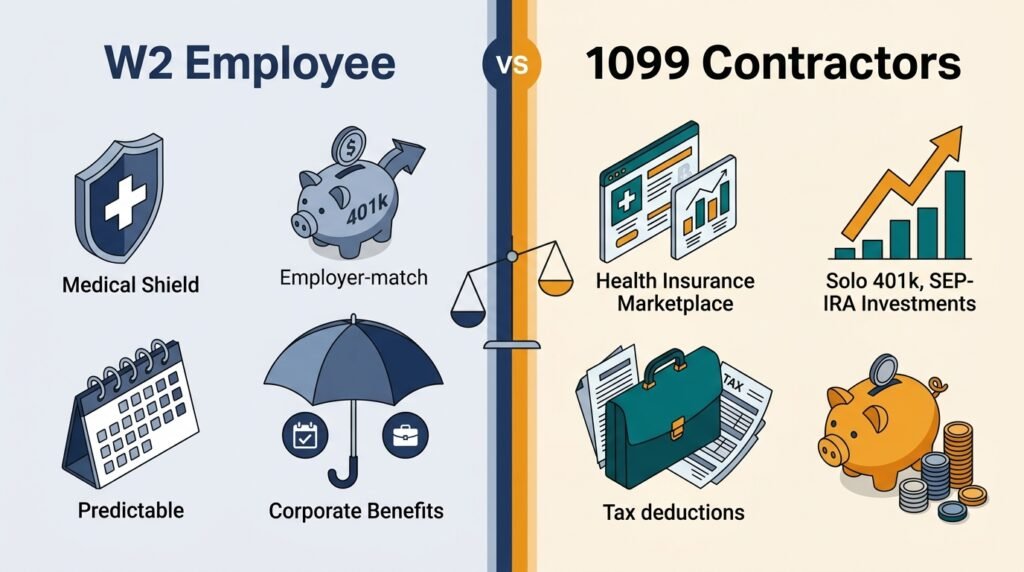
Health Care
Your corporate job likely paid most of the price of your health insurance premiums. What the 1099 employer-offered package lacks are the ACA Marketplace and other private individual health plan options that are available on ACA marketplaces. If you have lost your employer-subsidized group plan and go the self-employed route, you can choose your qualifying individual health plan, including coverage for your family as appropriate.
Retirement
401(k)s are no more and there are no employer contributions to put aside when you are your own boss. However, you can start an individual Roth or Traditional IRA or a SEP(Savings Incentive Match Plan) or even a self-employed 401(k) plan, each with individual contribution limits.
PTO (Vacation, Holidays, Sick Days)
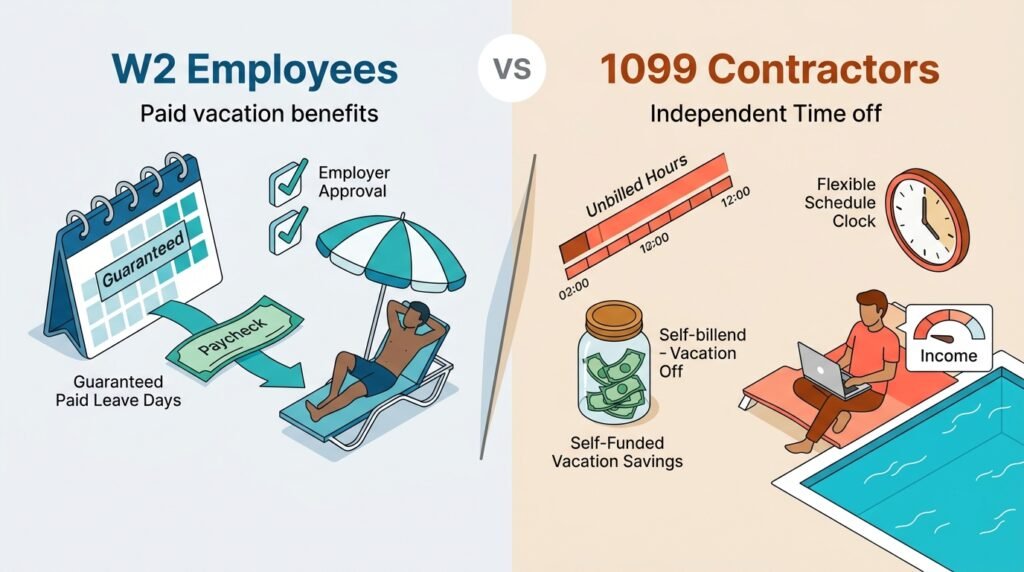
While a corporate job provides all sorts of paid time off (PTO), a 1099 contractor doesn’t get any sick days, holidays, or vacation pay. You get paid only for the work actually performed. Therefore, to offset the PTO costs, a contractor needs to bill higher rates compared to a W-2 employee. A good rule of thumb is to add another 25%-40% to the W-2 hourly rate as a 1099 contractor to offset the additional liabilities and unpaid time off.
Control, Autonomy, and Legal Status
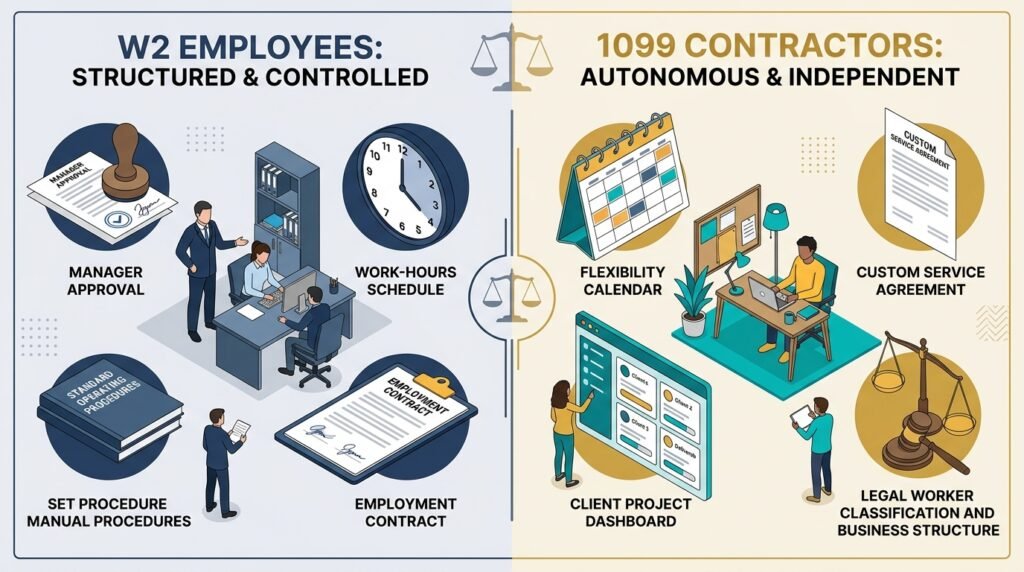
The primary appeal of a 1099 job is its flexibility, but the control is conditional. First, there is the control over your own work: how and when you do it, who you work for, etc. Second, your employer has limited control over you. By contrast, a W-2 employee is far more beholden to their employer’s wishes.
To determine whether you are an employee, the IRS looks at three categories:
- Behavioral control (how much say the client has in telling you what and how to do),
- Financial control (whether you have an opportunity for profit and loss, whether you can be fired for refusing to buy materials, etc.), and
- Type of relationship (existence of a written contract specifying the tasks, the lack of employee-like benefits, etc.). In essence, if the client sets your hours, requires exclusivity, or makes you buy equipment from them, they are likely to be classified as an employee.
Intellectual Property Ownership: What Belongs to Whom?
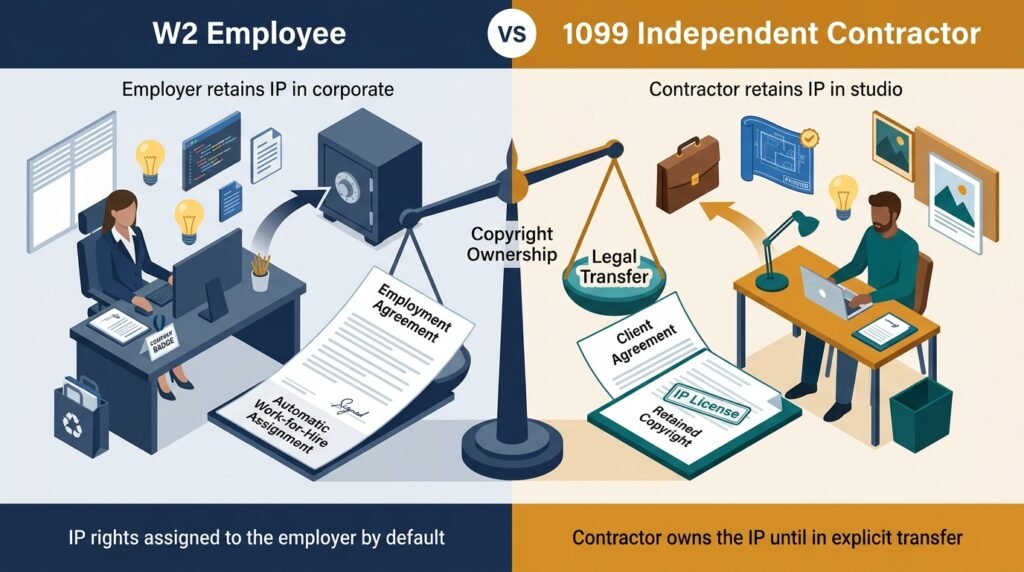
By default, everything created by an employee (program code, content, graphic design, etc.) belongs to the employer. However, for 1099 contractors, this depends on the specifics of the agreement: whether the client owns your work or whether you retain full or conditional ownership and provide the client with a license to use it. This nuance must always be specified in writing.
W-2 vs. 1099: Checklist
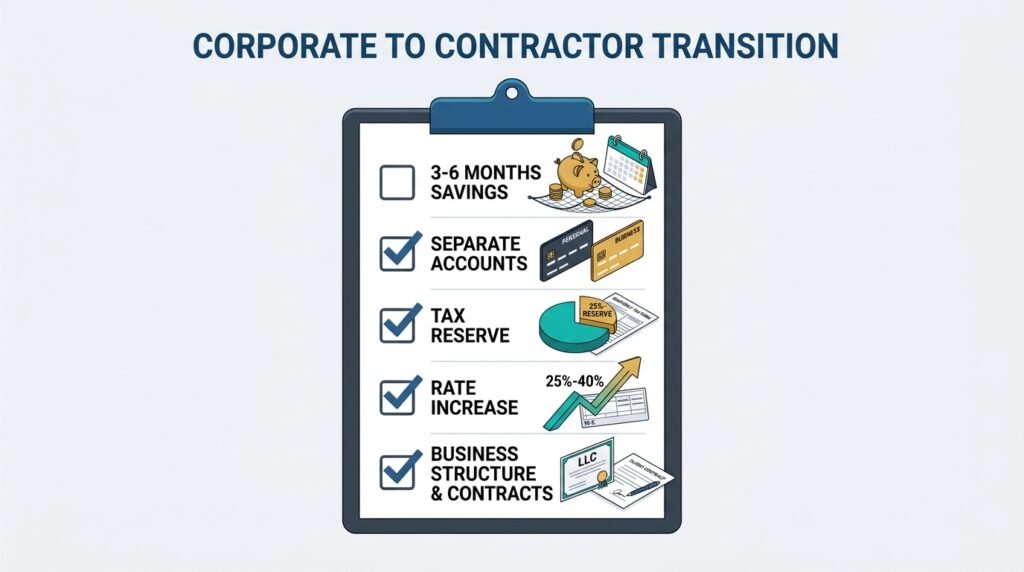
- Before you quit your corporate job and start working as an independent contractor, here are several essential items to add to your to-do list:
- Make sure you have at least 3-6 months of personal expenses saved in case you have an extended dry spell (no work, no income).
- Set up separate personal and business accounts (bank and credit cards).
- Make sure to reserve 25%-30% of business income to pay estimated taxes on a quarterly basis.
- Set your rates 25%-40% higher than what you were paid as a W-2 employee to compensate for additional expenses and taxes.
- Open a business structure (Sole Proprietorship or Single-Member LLC) and have contracts ready for your clients.
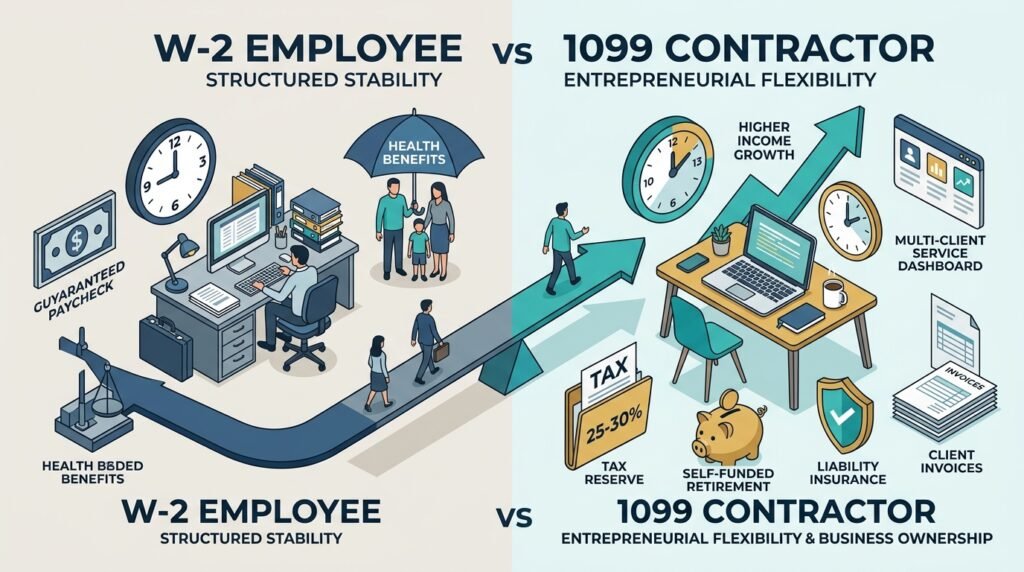
Leaving a W-2 job for a 1099 contractor position is all about trading stability for flexibility. And just like with any transaction, it’s crucial to know what you are getting into. As an independent contractor, your income potential is much higher, and you have more control over whom you work for and when you are paid. These benefits, however, come at the cost of a steeper tax burden and responsibility for funding your own benefits, liability coverage, and retirement. In general, you need a self-employed mentality for a 1099 job: a worker needs to think not of themselves as an employee but rather as a business owner trying to serve clients, get consistent work, and ensure a steady revenue stream.
The Site cannot and does not contain financial, tax, or legal advice. The information contained on this website is provided for general informational and educational purposes only and is not a substitute for professional advice. Accordingly, before taking any actions based upon such information, we encourage you to consult with the appropriate professionals. We do not provide any kind of financial and tax advice. THE USE OR RELIANCE OF ANY INFORMATION CONTAINED ON THE SITE IS SOLELY AT YOUR OWN RISK.