How Much Money to Save Before Quitting Your Day Job
Quitting your 9-to-5 without a financial safety net is the surest way to return back to a corporate desk. Mainstream financial advice will tell you to save 3 to 6 months of living expenses in order to be safe enough to quit.
This advice works great for people who work in traditional jobs and need a period of unemployment between jobs but doesn’t take into account those who are entrepreneurs or freelancers.
Those types of people require a larger safety net due to business expenses, self-employment taxes, and inconsistent payments from clients.
So before resigning your job, make sure to split your money into 3 different piles.
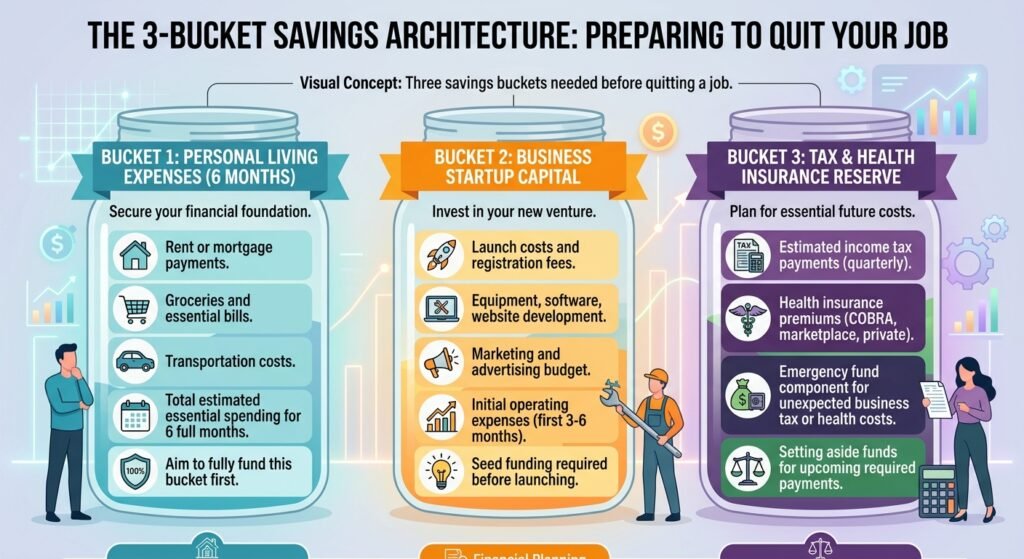
Bucket 1: The Personal Living Expenses Reserve (6–24 Months)
What is your personal reserve? It should include your housing, food, bills, debt minimums, and anything else that you absolutely need.
- Find out what you can get by as a bare minimum, not what you have now.
- Keep one to two years of expenses in this account. If you’re going into something that already has revenue, only save up six months’ worth of expenses. If you’re starting from scratch, save up one to two years’ worth of expenses.
- Whatever number you come up with, you’re going to want to stick it in a high-yield savings account (HYSA) and leave it alone.
Bucket 2: Business Startup & Working Capital
Launching the business requires you to invest in it before you see a cent of net income. So if you confuse your business expenses to your personal savings, it’ll be dried up in 90 days.
- Fixed setup costs are software subscriptions, registration fees (LLC filings, DBA certificates, etc.), website hosting, and equipment.
- Working capital is your money needed to fund your operations to reach a point where you can pay yourself a salary before worrying about more income. You need to estimate how much will be needed to fund at least 3 – 6 months of continuous client searches and project completion.
- A Break-even analysis will reveal the amount of revenue your business must generate to sustain itself before taking any money out as profit.

Bucket 3: The Tax & Benefit Buffer
Transitioning to self-employment alters the way that income taxes and healthcare overhead function.
- Self-Employment Tax: As an independent contractor or sole proprietor, you are liable for the entire 15.3% self-employment tax (Medicare + Social Security) on net earnings above $400, in addition to estimated quarterly payments.
- Health Insurance Gap: The cost of private market health coverage or COBRA can be 2x to 3x higher than employer-subsidized plans.
- Capital Reserve: Set aside 25%-30% of projected gross revenue directly into a dedicated business tax account from day one.
| Expense Category | Traditional Employee | Self-Employed / Freelancer | Savings Strategy |
| Income & SE Tax | Automatically withheld | Quarterly estimated payments (15.3% SE tax) | Set aside 25–30% of every payment |
| Health Insurance | Employer-subsidized | Out-of-pocket market rates | Include as a core line item in personal runway |
| Operating Costs | Covered by company | Direct business expense | Fund via Bucket 2 startup capital |
How to Build Your Runway While Working Full-Time
- Conduct a Cash Flow Forecast: Build a 12-month projection that outlines your cash-burning rate versus projected business revenues.
- Build a Side-Hustle Proof Concept: Land 1–2 clients on retainer or conduct market testing so that you can earn a salary in parallel with your full-time job.
- Open Business Accounts Early: Open business bank accounts right away to separate personal and professional funds, and be sure to apply for an EIN.
- Establish the “Quit Metric”: Do not quit your job based on impulse, and instead, have two objectives within sight before you transition: 1) 100 percent of the money in your 3-Bucket savings account, and 2) having at least 50 percent of your monthly corporate salary supplemented by another source of income for three consecutive months.
Our 3 Bucket Runway Calculator can provide an estimation for your financial safety net.
The Site cannot and does not contain financial, tax, or legal advice. The information contained on this website is provided for general informational and educational purposes only and is not a substitute for professional advice. Accordingly, before taking any actions based upon such information, we encourage you to consult with the appropriate professionals. We do not provide any kind of financial and tax advice. THE USE OR RELIANCE OF ANY INFORMATION CONTAINED ON THE SITE IS SOLELY AT YOUR OWN RISK.